

STAY CONNECTED WITH THE TRIATHLON COMMUNITY
Jarrett Pflieger
One of the great aspects about competing in the sport of triathlon is all the relationships you can form along the way. Training and competing alone is OK, but nothing beats the competitiveness and camaraderie of training and racing with a friend or a group.
Triathlon is a great way to meet new people that share your interests and athletic goals. The social aspect of the sport is what draws many people to it and keeps it growing. Meeting other athletes and staying connected is easier than ever before with all the tools available on the Internet. I’m sure many of you already have a Facebook and Twitter account, but if you don’t, I highly recommend you check them out.

Facebook.com and Twitter.com are great for keeping up with what’s going on in the sport, both locally and abroad. Triathica has accounts with both websites and we routinely send out updates, articles, tips, and announcements that are free to anyone. Aside from joining a local organization like the Orange County Triathlon Club, setting up an account with a social networking website is a great way to connect with other athletes, learn training and racing tips, find training partners, and more.
Check out our Facebook and Twitter posts and create a free account while you are there if you do not have one already. Please introduce yourself; we’d love to meet you.
SO HOW’S THE RESISTANCE TRAINING COMING?
Ron Saetermoe
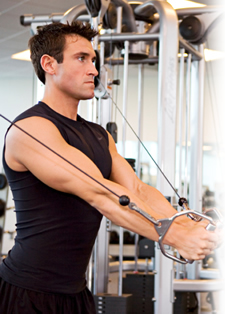 As you know, we’re huge advocates for resistance (strength) training here at Triathica. Jarrett takes the lead but I’m really concentrating on this for 2010. I’m going to need it if I’m going to qualify for Kona. (Did I say that out loud?)
Alyson Wolfe, a grad student at Cal State Fullerton, helped us formulate the Triathica program. It’s really coming together quite well. So well, that I expect we’ll turn it into a book at some point.
I’m validating our program now as the designated Triathica guinea pig. I can tell you that it is definitely kicking my butt! Who would think that you could hurt so badly without lifting 200 lb weights?
Actually, I see my muscle pain as a very good thing. I feel my core, upper body but mostly my legs getting stronger (which is where I really need it).
I had a couple thoughts I’d share with you that may help improve your triathlon performance next year:
1. Get on a resistance-training program. If it’s not ours, get with someone. You’ll see better performance in your races and help reduce injuries.
2. Get started right away. I started my program last week (twice a week) and since I’m so sore, it’s compromising my swim, bike and run training. Delaying your resistance training until you’re already into your season will compromise your training too.
3. Start off easy. It may seem ridiculous doing so few sets with so little weight to start, but a slow build will help you make consistent gains without injuring yourself. The same goes for swim, bike and run training.
4. Many of the exercises can be done at home. Get yourself a fitness ball, some bands and perhaps some dumbbells so you can do many of the exercises at home. Even though I have a 24 Hour Fitness membership AND MY OWN GYM, I still find it convenient to work out at home periodically.
5. Always use proper form. It amazes me to see men and women at the gym hoisting these huge weights and using lousy form. Just like your swimming, cycling and running, form is critically important. Without proper form, you won’t get the maximum benefit and will dramatically increase the chances of injury.
We’d enjoy hearing about some of your resistance training ideas as well.
TRIATHICA NEEDS YOUR HELP!
Ron Saetermoe
 I’ve been very fortunate to have a successful automotive marketing and consulting company for 19+ years. It’s given me a good life and I’ve done some very rewarding work. Let’s face it, Automotive Associates has allowed me to pursue my passion.
My passion, as you know, is triathlon. It’s been about two years since I started looking for a niche in the triathlon space and discovered that there weren’t any gyms specializing in triathlon; in the world! Could there be an opportunity there?
Jarrett came on about six months after my epiphany and started researching the market. Of course the research looked good at the time so we developed our business plan and opened the business in June this year.
So far it’s been really great, but we need your help. Mostly we need to spread the word about Triathica and we’ve got a great vehicle to do it with . . . the Triathica Triathlon Roadmap.
By simply entering your email address you get a free copy of the Triathica Triathlon Roadmap – a $19.99 value. How much easier could it be? If you’re already on our email list you can download the book for free right now.
Perhaps the easiest way to help us is to forward this email newsletter to everyone you know and have them sign up for the free copy. Simply point them to the Triathica Triathlon Roadmap box on our homepage at:
www.triathica.com
We really appreciate your help.
Cheers!
PERIODIZE YOUR TRAINING
Jarrett Pflieger
 Are you the type of person that does the same workouts week in and week out and constantly tries to improve on your last training session? Please stop. You will save yourself a lot of time and maybe even get faster in the process.
Many athletes fail to realize that our bodies need rest. There’s a little voice that tells us to train faster, longer, and more often or we won’t get better. That is true to some extent, but we forget one very important aspect . . . our bodies need to recover through rest.
That’s right, you can’t get better if you don’t recover and adapt from your workouts, and you can’t recover if you don’t rest. Periodizing your workouts ensure that you get the appropriate amount of rest, while still continuing to vary and build on your workouts to get better. So how do you periodize your current training?
There are many views and opinions on this matter, but one system that seems to work is based off five phases; adaptation, base, build, race, and transition. With each phase, you change up and focus your training to build up a different part of your fitness. Adaptation phase brings you slowly back into training from your off-season. Base phase consists of easy and longer workouts to build up your aerobic base. Build phase continues to build off that base and incorporates more speed work and intensity to increase your speed and endurance. Race phase contains your most intense training sessions leading up to your race, but also incorporates at least a week or two of tapering depending on the distance you are racing. Tapering is reducing your training volume and intensity so your body can absorb your very intense race phase training so that you reach your peak fitness on race day.
With this method, you basically break up your year into five phases of training of nine-weeks each. The remaining weeks in the year are used for whatever you want. Each nine-week “macrocycle” contains three “microcycles” within. The microcycles consist of a moderate week, a maximum week, and then a recovery week. This allows you to start out pretty hard, max out the next week, then recover the third week. Some athletes can do a three-week build then one recover, while others might need to recover after each hard week of training. It really depends on the athlete but a two-on, one-off scheme seems to work for most. By increasing your fitness gradually in cycles, you can better absorb your training and prevent burnout or overtraining.
Just play around with it and see what you can accomplish this season. Definitely consult a certified triathlon coach if you are unsure about putting together your own training plan. Make sure you get plenty of rest and are frequently varying training duration, speed, and intensity to get the most out of your workouts.
DEVELOPING YOUR TRAINING WEEK
Ron Saetermoe
After you’ve mapped out your race year you’ll want to develop your weekly routine. I highly recommend getting into a routine so you can adequately prepare your body and mind.
We all need motivation to train. It might look easy when others get up at 4:00 a.m. when it’s 40 degrees outside and jump into the pool, but it’s not. Getting into a routine and getting committed to it will help a lot. Better yet, recruit (con) another athlete to train with you. Misery loves company!
When developing my weekly plan I look at my schedule day by day. Do I have any routine commitments (like work) to consider? I take tennis lessons Monday evenings with my son, so any training I do must be done before or after that.
Then, I look at how much time I have available (and how much I want to train) each day. Since I’m a morning person I schedule one training session every morning. And since I do work, I schedule another session every Monday – Thursday evening. That’s right, us hardcore triathletes train twice a day!
Fridays for me are recovery days to help me get some rest for the endurance stuff I do on Saturday and Sunday so I only do one workout. Saturday is generally a long bike ride of 3 – 8 hours with a transition run. Sunday is a long run of 1 – 3 hours preceded by a short bike ride. This sequence has me running Sunday on tired legs from Saturday . . . just like my races.
I made a couple changes in my training from last season. The most notable is the addition of resistance (strength) training. If you’ve been reading this newsletter you know what a strong proponent of resistance training Jarrett is. I did my first two sessions this week and they kicked my butt! I see that as a good sign.
The other big change I’m making is reducing my swim workouts and increasing my cycling workouts. I generally finish the swim in the top 10% of guys in my age group but I usually only finish in the top 25% of cyclists. And since the bike portion of the race takes more time, this change makes sense.
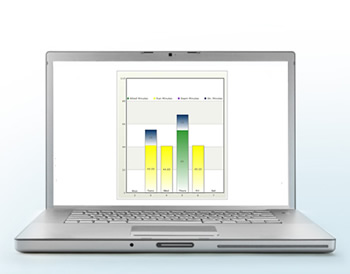
The following chart is what a “moderate” week in the “build” period looks like for my Ironman training:
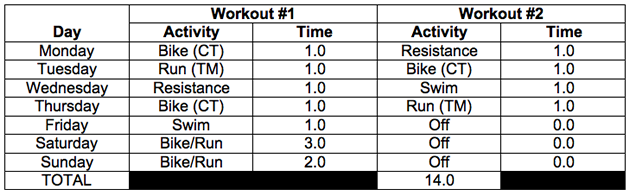
CT = CompuTrainer
TM = Treadmill
Develop your own weekly plan and you’re on your way to a better season.
MAKE 2010 YOUR YEAR!
Ron Saetermoe
 Yesterday I tried signing up for the Carlsbad ½ marathon (I LOVE racing this distance). Sold out! Then I tried signing up for the Vineman 70.3. Sold out! Guess what, it’s not too early to start thinking about your races for 2010. In some cases you’re already too late.
I’m told that Ironman Arizona sold out in 24 minutes. Okay, think about that for a minute. You pay $550.00 for a race a year in advance x 2,400 people = $1.3 million!!! I want that gig!
If you really want to do well racing next year you need to be thinking about the races you’re going to do, sign up, and develop your plan. I normally do about 10 triathlons a year and another 8 – 10 running races. That’s a lot for most athletes, but I love to race.
Racing is fun but if you’re trying to make the podium, you need to do more than just register for races and train – you need a plan of attack.
First, don’t try to do too many races. “Too many” is a relative term. 10 may be too many for some whereas 20 might be just right for others. Use your recovery time as a guide. Older, or less fit athletes will take longer to recover than extremely fit, and younger athletes. You’ll want to have time after your races to fully recover, AND have time to gear up for your next race. If you race EVERY weekend you’re not giving yourself enough time.
Second, pick your “A” races carefully. Your “A” races (1 – 3 per year maximum) are the races you feel you really want to perform your best at. You’ll want plenty of training time and taper time before these races.
Third, think of your “B” and “C” races as “catered workouts.” You’re going to race them but you’re not going to need to be carried off on a stretcher at the end of the race. These races help keep you sharp and give you confidence for your “A” races.
I “age up” in 2010 (I’ll be 35 . . . again) so I’m planning my year VERY carefully. I’ve already registered for Ironman Arizona again because I feel this will be my best chance at qualifying for Kona. I’m also going to try to register for Ironman St. George and Ironman Canada at Ironman California 70.3. We’ll see if I get in.
All of my Ironman races will be “A” races for me. I feel that I’m able to consider three Ironmans “A” races because they’re spread out enough. I’ll have plenty of time to train and taper before my big races.
If you haven’t mapped out your races yet you’d better get on it!
Cheers!
ROAD BIKE VS. TRIATHLON BIKE: WHICH TO CHOOSE?
Jarrett Pflieger
So you are trying to decide which bike to use/buy for your first or next triathlon race. What are the differences between a road bike and a triathlon bike? Which one should you choose? The answer is actually simpler than it may seem.
Without getting into detailed technical differences between the two, there are a few major things that set the two types of bikes apart.
Tri Bike vs. Road Bike:
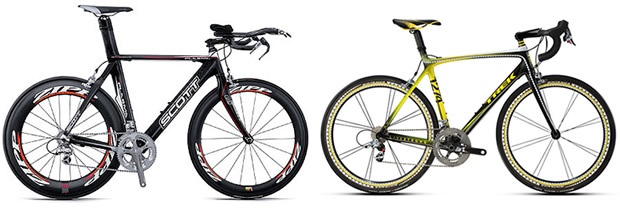
A tri bike is specifically designed to be ridden as fast as possible while minimizing drag and energy expenditure by the rider. To increase aerodynamics, tri bikes are fitted with aero bars that allow the rider to lean forward and rest their forearms on pads located on top of the handlebars. This exposes less total frontal surface area and allows riders to cut through the wind instead of acting like a sail as if their body was in an upright position.
The seat tube angle is also steeper on a tri bike than a road bike. What this means is unlike a road bike where the seat angle points towards the rear of the bike, the tri bike’s seat in more vertical. This positions the rider closer to the front of the bike and allows the rider to maintain a larger hip angle while in the aero position. This benefits the athlete by allowing them to utilize hamstring and glute muscles more effectively without relying too much on the quad muscles. You need as much energy in your quads that you can manage when it comes time to run off the bike, so minimizing quad strain on the bike portion of the race is crucial to fast triathlon run and overall times. In terms of pure speed and saving energy, a triathlon bike is king.
A road bike is designed a bit differently. They are meant to be more dynamic, maneuverable, and optimal for power production due to constant changes in terrain, breaking and sprinting by fellow riders, and overall unpredictability of the pure cycling races. They do not have aero bars and are meant to be ridden mostly in a relatively upright position with hands on the top of the handlebars. The seat tube angle is less steep which allows for better power production since you can better utilize the powerful quad muscles.
Which bike should you choose?
The short answer is…it depends. If you are new to triathlon, use whatever is available. Whether it is a used road bike on eBay, old mountain bike in the garage, beach cruiser, or pink huffy, it doesn’t matter. If you are a new triathlete, don’t spend money before you absolutely know you will continue with the sport. You won’t set any records your first time out, so don’t worry too much about it.
If you have done a few triathlons and are ready to buy a bike but don’t have the money for a full triathlon bike, a road bike with a set of aero bars strapped on works just fine. You may shave a little time with a tri bike, but road bikes are usually cheaper and more easily accessible than tri bikes and unless you are a very good athlete, the differences are negligible.
If you have a few races under your belt and are starting to become competitive in your age group, or plan on it in the future, definitely think about getting a triathlon bike. If you are a complete newbie, but want to blow a few grand on a tri bike just because you can afford it, go for it. It makes it easier for us athletes on a budget to pick up a barely used tri bike cheap on Craigslist when the owner decided they didn’t want to do triathlons anymore after only a few races.
Bottom line, when trying to decide between the two types of bike, just go with whatever is easier for you to get. Beginner triathletes are better off buying a used road bike with aero bars and putting the extra money they saved into some good coaching. Trust me, it will save you more time in the long run than an expensive triathlon bike.
IF THE BIGGEST LOSER CAN DO THIS, SO CAN YOU
Ron Saetermoe
If you’ve ever done a triathlon, of any distance, you’ve probably had at least one person tell you “I could never do a triathlon.” I’ve actually heard it a bunch of times and my response is always the same “Yes, you can.”
Now, I’m a positive person, but I’m not one of those people that tells everyone they can do anything if they put their mind to it. If that’s true then why don’t we have a cure for the common cold?
I do, however, believe that almost anyone can do a triathlon if they put in the time and work with a plan. I’ve seen it many times. If you hang around a while, after nearly any race, you’ll see the people that defy logic. Young kids, overweight people and people so old you wonder how they stay upright without a walker.
Bill Bell is one of those guys. He’s slowed down a lot in recent years, and has had multiple knee surgeries, but he’s still out there doing it at age 80!
Attached to this article is a YouTube video of an equally inspiring dude, Matt Hoover. Matt Hoover was the winner of the NBC television show “The Biggest Loser” back in 2005. I won’t say too much about the video other than you should grab a tissue or two before you watch it. 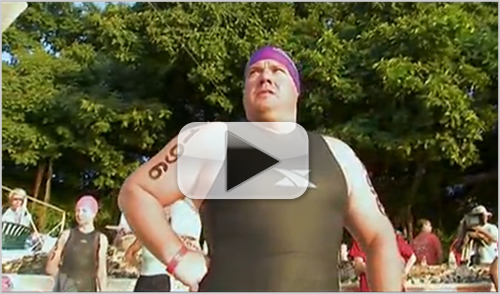
The people in our sport are amazing. I guess one of the reasons I enjoy it so much is that those that are in it constantly inspire me. I’ve been lucky to know some great triathletes and coaches that have given me the confidence and guidance to help me reach my triathlon goals.
I feel blessed to have the opportunity to work with so many athletes here at Triathica. I try encouraging everyone to reach his or her own individual goals while I keep my own in sight.
You CAN do this!
Cheers!
DO YOU TEMPO? HOW TEMPO RUNS CAN MAKE YOU FASTER?
Jarrett Pflieger
 What exactly is a tempo run and how can you incorporate them into your training to make you faster?
A tempo run is basically a higher paced workout that is faster than an easy run, but a bit slower than race or interval pace. The goal of a tempo run is to sustain a constant speed over a specified distance. How far that distance should be depends on your race distance and what cycle of the season you are in. The pace you should run at depends on your current fitness level and running ability. A good rule of thumb for tempo workouts is that it should be done at a comfortably hard pace. It should be fast, but under control and sustainable.
When you are running at tempo pace, lactate and hydrogen ions are being released into your muscles. These eventually cause your muscles to become acidic and you begin to fatigue and feel “the burn.” During tempo runs, you are training your body to use these byproducts more efficiently, enabling you to run at a faster pace without fatiguing. This point of fatigue is also known as your lactate threshold. Raising your “threshold” is key to being able to hold a faster pace for longer time periods.
Many people make the mistake of focusing too much on long and slow runs to build aerobic base. There is a need for this type of training, as it allows the body to deliver more oxygen to the muscles, but tempo training increases the body’s ability to use that oxygen once it gets to the muscles. You need to incorporate both in your training to reach your potential as a runner.
So how long should your tempo runs be? Well, it depends. The minimum tempo run should be around two to three miles or 15-20 minutes long if you are training for a 5K or a sprint triathlon. Anything less than that and you will not get much benefit. For longer distances like a 10K, four to six miles is probably sufficient. Marathoners or Ironman triathletes will benefit from eight to ten mile tempo runs.
Tempo runs are best performed during peak training weeks since they are relatively high intensity training sessions. Instead of trying to increase time or distance of your tempos, try to increase the speed you can sustain over a fixed distance. Intensity has been shown to be a better stimulus for physical adaptation than volume or duration.
Before going for a tempo run, it is important to thoroughly warm up for 10-15 minutes since you will be running at a high intensity and the risk for injury is higher during these times. Make sure you also cool down for 10-15 minutes at a nice easy pace. Throw in a tempo run once or twice a week and watch your speed increase and your run times drop.
STAYING MOTIVATED
Ron Saetermoe
We’re in the off-season now. How do you know? Look at the rolls beginning to form around your waist!
It’s hard staying motivated during the off-season, especially if you’ve trained and raced hard. So how do you do it?
For me, daily exercise is the norm. A day without exercise is like a day without brushing my teeth. Something’s missing. So these days it’s hard for me not to exercise. How sick is that?
I know that’s not normal, and it’s taken me many years of this twisted behavior to get there, but that’s me. If you’re not like me you may need a little motivation. Here are a couple ideas:
• Exercise with a group. There are plenty of them out there. Most of the triathlon clubs have group workouts and there are plenty of running and cycling clubs.
• Use a training plan. Yes, even during the off-season a training plan can help. Your workouts may not be as long or as intense, but many people find that this structure helps keep them on track.
• Concentrate on your “limiter.” Your limiter is the event you’re weakest at relative to your competition. For me, that’s the cycling leg so I’ll concentrate on doing more cycling during this period.
• Start a resistance-training program. Too many triathletes blow off the resistance (strength) training thing. The off-season is a great time to pull back on the swim/bike/run training and do more resistance training.
• Don’t go home after work. This one gets me most of the time. If I can do my workout immediately after work instead of going home, the chances that I’ll actually get my workout in is expontially higher.
• Watch triathlon videos. We’ve got a bunch here at Triathica and the Universal Sport channel broadcasts triathlons from time to time.
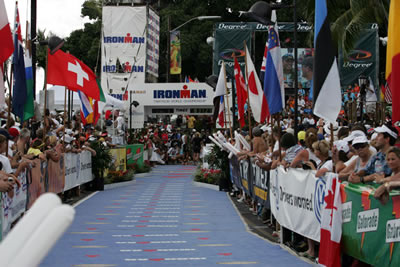
• Register for an early season race. I’ll be doing the Desert Triathlon out at Lake Cahuilla again next year on March 7th and the California 70.3 on March 27th. The “threat” of these early season races helps keep you motivated to stay fit.
I’m sure there are many more ideas out there but these are a few of my favorites. Oh yeah, and don’t forget, we’re here at Triathica to help keep you motivated too.
Cheers!
