
MAINTAINING YOUR FORM
Ron Saetermoe
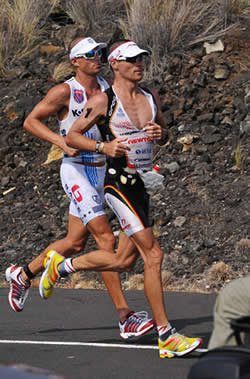 Excellence in athletics has a lot to do with your form. And while perfect form is impossible to achieve it is something we all need to strive for on the swim, bike and run.
It is possible to do well in triathlon even though you don’t have great form, however. Some folks make up for their form in other ways such as their strength or determination.
Russ Jones is one of those guys. While my form is far from perfect it is far better than Russ’. The thing is that when Russ and I race together we’re usually getting out of the water at about the same time.
I remember Strawberry Fields sprint in 2007. The surf was quite high that day which is usually a good thing for the stronger swimmers. On this day, however, Russ came out of the water just behind me and passed me on the beach run into transition. How’d he do it?
In Russ’ case it’s all about determination. You see, when he attacks a race he’s going all-out in each of the segments. He’s going at 100% on the swim and doesn’t even think about the bike until he’s riding. So while I “should” have beaten him, he actually beat me by two seconds.
Here’s the difference, if you can race at 85% of your maximum effort you’ll have more energy for the events that follow. Not everyone can go at 100% for an entire race, especially the longer stuff. That’s why your form is so important.
The swim is perhaps the event that depends the most on good form. You can usually tell whether a swimmer has good or poor form pretty quickly. They’re movements are fluid like they’re hardly working at all. The body rotation is excellent, their arms are reaching way out there and their “catch” is nice and shallow.
I think the run is the second most important to concentrate on. There is a lot of debate on what good form looks like for the run but bad form is easy to spot. Some say a forefoot strike is best while others say mid-foot is best. Others say a heel strike is fine. Frankly, I don’t know what’s best. There are so many opinions about it that it’s impossible to know.
I don’t know the guy, but the winner in the M50-54 age group at the OC Duathlon has the goofiest running form I’ve ever seen . . . but he did win. Again, while form is important, it’s not everything.
Generally, the best runners have fluid movements (just like swimmers). They don’t look like they’re working that hard, but they are going fast. They generally have their hands high and their heads don’t bounce much.
And while cycling form is perhaps the least important, it is still crucial because about 50% of any distance race is about the bike. Good form on the bike starts with a good bike fit. Again, there are lots of schools of thought here but here’s my take . . .
First, I think your bike position can be more aggressive (more forward in the saddle and back flat) for the shorter race. However, trying to do an Ironman in this same position might be impossible because it’s so painful to your back and neck. So, while position is important, comfort is just as important.
The other thing I notice about the best cyclists is that there isn’t a lot of body movement. My pal Larry Davidson has excellent form. I really noticed it a couple years ago at the Desert Triathlon as he blew by me. I’m working like crazy and my body is bouncing up and down and moving back and forth. Larry’s going faster than me and there’s no body movement. His legs are turning over but his body is perfectly still and his arms and legs are tucked in tightly.
So the place to start is to get someone to look at your form and then practice it. Yes, I hate drills too, but “perfect practice makes perfect.” And during your workouts really concentrate on your form to make sure you hold your form even as you tire or exert yourself. I think about it the most when I’m swimming. When I’m doing my speed intervals I’m thinking about my body position, my hand entry, even what my feet are doing.
If you want to get faster you need to be constantly working on your form. Get some help and you’ll get there.
ACHES AND PAINS
Ron Saetermoe
 It’s funny but the less I workout the more pain I seem to have. Why is that?
I just finished my first week (of two) of taperinig for Ironman 70.3 Hawaii and my training volume is down about 30% from my peak weeks. I’m really enjoying the extra time for doing all of the non-triathlon stuff but I’ve got all these aches and pains that weren’t there before.
It could be that I’m spending some of my extra time contemplating my belly button or it could just be nerves. Don’t know, but I’m pretty sore right now.
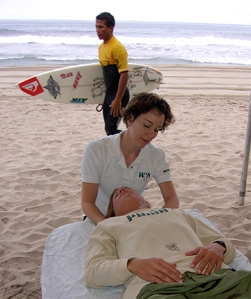
No matter, I’m going to go see my favorite massage therapist, Kathy Flippin of Dynamic Touch in Costa Mesa (www.dynamictouchmassage.com / 714.345.7188). I know Kathy’s magic hands will fix me right up.
I’ve experienced this phenomenon before so I’m not worried. It’s like Faris Al Sultan said once before he won the Ironman World Championships (paraphrasing) “Everyone has a little problem here and a sore muscle there, but when the gun goes off you are a 100% racing machine.”
It’s true you know. Starting in December 2009, I haven’t done a proper taper for any of my races. My goal is to concentrate on my training more than my racing and just use the races as quality training days. So far it seems to be working although I’ll e the first to admit that my racing performance is surprisingly good – even going into my races fatigued.
My pal Russ Jones actually warned me about tapering too much before my Hawaii race because I’ve done so well without tapering. The thing is, I know my body pretty well by now and know I’ll do better with a taper.
So if you’re in taper mode and notice all kinds of aches and pains, consider it normal. You’re in good company.
Cheers!
RACE REPORT: OC DUATHLON
Ron Saetermoe
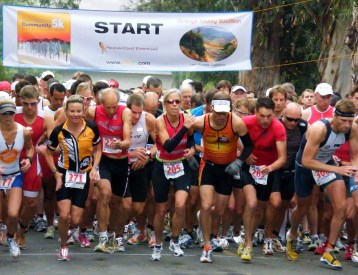 I’ve never been a big fan of the duathlon because my strongest event has always been the swim. But just to give it a shot I did the OC Duathlon last year just for kicks, and training.
Getting on the bike AFTER a RUN was something I never practiced for (I have since, however) so it was a little weird last year. I felt like I had a good race (for me) and finished 6th in my age group with a 1:51:57. Not too shabby.
So this year I was going into the race with higher expectations but didn’t do any tapering for it whatsoever since this was really just an intense training day for me. Funny how we still expect more even though we do less preparation! And I KNOW it’s not just me!
I’m up at 4:00 a.m. and jump into my racing clothes and sweats and grab breakfast. English muffin with peanut butter and jam, glass of OJ and cottage cheese with blueberries and walnuts. Same thing I eat every race morning. I think I over did it this morning though because I felt really heavy.
Made my way to the race site and got a spot near the end of the bike rack – the end near the start/end chute. Used the porta potty a couple times and chatted up some of the other racers. No pressure!
I told my buddy Russ Jones to watch for me because I had him in my sights. His comment? “Sure Ron.” He knows me too well to be worried. We’re in the same age group again so I know when I race against him the BEST I can hope for is 2nd unless he flats. Heck, even if he does flat I’ll still probably come in 2nd.
The morning was cool. A perfect day to race. And plenty of friends racing too. It was going to be fun.
The run starts out downhill so it was fast. My first mile was 6:02! Whoa, big fella, you’re not an 18:00 5k guy! The next couple miles were considerably slower. I could see my pals Russ and Scott Calendar up ahead. No way I’m going to try to go with them.
My goal was to press hard on the bike. At the Californian 70.3 I managed to average 192 watts for the entire 56 miles so my goal today was to go 200. Sounds easy, doesn’t it.
I did go hard and managed to pass more riders than those that passed me. I saw my pals Dave Aronne and Stefani McMillen. I’m pretty slow up hills but hold my own in the flats and no one passes me on the downhills. My goal is to try to keep my wattage within a range no matter what the terrain.
The bike went well and I managed to average 198 watts. Only 1% less than my goal.
If you’ve never done a duathlon before you don’t know how much the second run sucks! Most people, including me, go out too hard on their first 5K and don’t hold enough in reserve for the second 5K. It’s fun to look at the disparity between the first and second 5K times. Most are a minute or more different.
The 2nd 5K was the same fast start as the first 5K, which my legs really appreciated. My pace was slower but still under 7:00 which is still good for me. My legs felt like rubber and my heartrate was climbing.
Since the run was an “out and back” you get to see a lot of the other athletes out there. Good old Stan Gertler was still yelling words of encouragement to everyone he knows. He’s a great sport!
That last ½ mile really hurts because you’re toast anyway and it’s uphill. I passed Pete Kobrick who was the race’s official bike mechanic. He yelled out “Good job Ron. No one even close behind you.” That’s good, because I’m too tired to look . . . or care, at the moment!
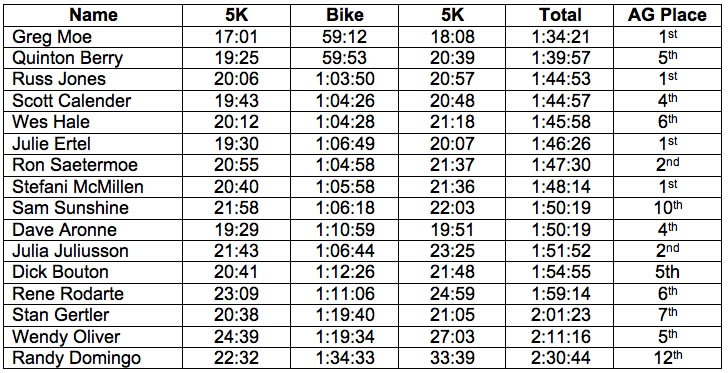
I was very pleased with my race and finished a predictable 2nd behind Russ. 4:27 faster than last year. Cool!
Here are some of the times from my mates:
THE BIG BUILD UP
Ron Saetermoe
 I’m just about two weeks away from my first “A” race of the season: Ironman 70.3 Hawaii. I didn’t have this race on my original schedule but since I did so well at the Ironman 70.3 California I figured I’d add this race to try to qualify for Kona.
So this is the “big build up” as well as the “taper.” It’s a build up because all of the excitement and emotion before your really big race. I’m already starting to pack. I’ve had my bike checked out once, and will do so again when I leave it at Edge Cyclesports for TriBikeTransport to pick up. I’m double-checking my flights and hotel accommodations. Check, check, check!
No sleepless nights yet but there will be as we get closer to race time. I get into Kona on Thursday, June 3rd. Since the race is Saturday I’ll do my really big carbo-loading Thursday night. For some reason I just don’t race well when I’ve eaten a big meal the day before a race.
I’ve checked in with Dr. Sam Sunshine about his advice. Increase the salt intake a week prior to the race and drink lots of fluids a couple days before. Check!
I’ve been to the website numerous times to check on who’s racing and then gone to Athlinks to see what their race results have been. Check!
I’ve also invited Oguz my partner in the Triathica Academy and my 15-year old son to come along with me so I’ve had to revise the travel plans. Check!
I’ve had lunch with Al Gaspari, a great age group competitor to discuss his experience at the same race two years ago. I’ve also called Kirk Matkin and asked for his advice as he’s done the race numerous times. Check!
Frankly, it’s all a bit exhausting! After all this I think the race will be the easy part.
The best you can do is just check and recheck everything because this will help prevent an over stressed situation come race day. Be sure to taper appropriately and rebuild the muscles you’ve torn down from the previous training.
Two weeks left. Can’t wait!
Cheers!
GETTING SERIOUS ABOUT YOUR FITNESS
Ron Saetermoe
 As I said in my previous article, I don’t think you need to get serious about triathlon to have fun. However, if you really want to go to the far reaches of your health and fitness you need to go see Dr. Herman Falsetti.
I first learned of Dr. Falsetti years ago when he did a short presentation at an Orange County Triathlon Club meeting. A soft-spoken man, his persona doesn’t reveal the expertise he really possesses.
He is a well-known authority in the field of sports medicine and a board certified cardiologist and the one many of the world’s top triathletes have relied on for decades. And while he doesn’t like to talk about his may high-profile clients his walls are littered with photos of people like Lance Armstrong.
I hadn’t been back to see Dr. Falsetti since 2006 mostly because my insurance doesn’t pay for his services. However, I strongly recommend you call his lovely assistant Carrie Gillett to see if yours does. My good friend and fellow triathlete K.C. Heidler’s insurance does cover his so he’s there every quarter.
So what can you expect? Carrie will check your height and weight and Dr. Falsetti will take some blood. I never even felt the needle going in!
After that they’ll hook up about 10 electrodes and have you rest on a table for a few minutes to get your resting heartrate. Note: It’s also a good idea to check your resting heartrate before your appointment for reference.
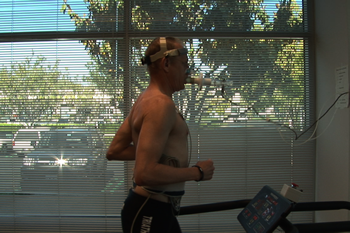
After that, let the fun begin! They have two tests to choose from: the bike or the treadmill. I chose the treadmill because I can get my heartrate up higher. You then climb on to your chosen device of pain and you’re off.
I’m not sure how the routine goes for the bike but the treadmill starts off very slow. About half way though each interval Dr. Falsetti’s assistant will ask you your level of pain on a 10-point scale. Then every two minutes the treadmill speeds up. Eventually the speed maxes out. Then the fun really begins! The elevation of the treadmill keeps increasing until you have to stop.
Based on the information he gathers he can tell you what your VO2 Max is as well as your training zones. It’s really great stuff and might help you reach the pinnacle of your fitness.
You can find his website here.
HAVE FUN
Ron Saetermoe
 Non-triathletes don’t get how training for and racing triathlon can be fun. You get up at all hours of the morning to train and sweat your brains out. You wear funky clothes and spend thousands of dollars on bikes and other equipment. Silly isn’t it?
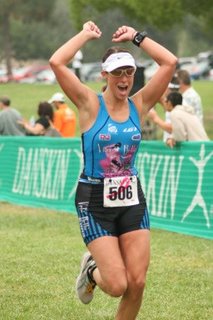
For me, the fun I get from the sport, has evolved. I think it does for a lot of people. In the beginning it was just a kick to get out and finish a race. You can see the same looks on the faces of the age-groupers that finish in the bottom 50% as well. They don’t care about their time, they were just happy to get out there and do it.
But as I have taken my racing to new levels my idea of “fun” has evolved into something else. I now “hang” with some very competitive men and women who inspire me. In addition, I train a lot longer and harder. And, when it comes to my equipment, I demand the best.
Just this morning, in fact, I just bought a Tyr Sayonara Swimskin that I will use for exactly one race! You see, wetsuits aren’t allowed at the Hawaii Ironman 70.3 but swimskins are. And, since swimskins will be illegal in non-wetsuit races after September 1, 2010, I won’t use it ever again. Anyone in the market for a slightly used Tyr Sayonara after June 5th?
But I really don’t think having fun in the sport of triathlon requires you to continuously improve your times or position within your age group. I think many people just like the triathlon lifestyle and the people in it. It inspires people to stay active and healthy.
I know several longtime triathletes that like the sport because it gives them an excuse to travel. They’ve been to many races all over the world and don’t seem to really care if they qualify for Kona . . . ever.
I love the line in “Arthur” with Dudley Moore where he’s drunk again and he’s saying to his hooker escort for the evening “Isn’t fun the best thing to have?” Yep, it’s pretty great.
If you’re not having fun in the sport, no matter how you place, it’s time to move on to something else. Me? I’m having the time of my life!
RACE REPORT: IRONMAN ST. GEORGE
Gary Clendenin
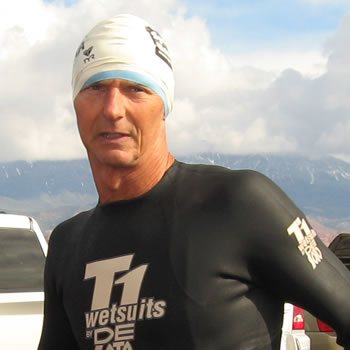 This race report was written on Tuesday May 4th, 3 days after IMSG. Before I describe the race, I would like to talk about the build-up, because it seems like the build-up should give one an indication about performance expectations. This is only my 3rd IM, the previous two being at IMAZ in April 07 and 08. In April 07 I had a decent race given it was my first attempt and finished 4th in the M55-59 AG. In April 08 I felt better prepared, but DNF’d after pulling the plug after 8 miles in the run. My excuse for bailing was the heat and wind, which put me in a very dehydrated state. When IMSG developed the course looked interesting and the event was relatively close to my home in Southern California. I thought this would be a good year to do another IM in preparation of next year when I age up. In other words, I really did not have any great expectations this year, but wanted to go through another IM training cycle and gain the experience of racing another IM. I did a 20-week IM build-up and, unlike most buildups, was able to hit all of the key workouts and, more importantly, managed to avoid any major injuries and sicknesses. I spent a long weekend training in SG about 6 weeks before the race. I knew the course was going to be challenging so I did more hill training on the bike and run than usual, including a bike ride about 5 weeks (coinciding with my last 7 hr ride) out from the race that included 14,000 feet of climbing over 114 miles. I used this ride to practice pacing and nutrition. I thought the build-up and preparation was excellent going into the race. I don’t really like to set time goals, especially on a tough course, but one of my co-workers caught me at a weak moment and managed to get numbers out of me. So reluctantly, this is what I told him: Swim – 1:05: Bike 6:00; Run: 4:15. We’ll see how these numbers compare to actual numbers.
The Swim
I don’t like cold water. Apparently, a bunch of people hated cold water even more than I did. I got in the water about 10 minutes before the start and looked around and saw hundreds of folks still up on the shore (it was a deep water start). I went straight to the front of the start, wide right. My goal was to find flat water and angle into the first buoy, which appeared to be about 800 meters down the reservoir. By the time the gun went off things started getting a little crowded up front, but I got a good start and to my surprise found flat water pretty quick. Things got a little congested at the first buoy and then opened up again. I never really felt like I was swimming hard–maybe at 80-85% max effort. I had been working on more of a “wind mill” type open water stroke and this seemed to feel pretty good. About 500 meters from the exit I started getting cramps in my left lower leg and right calf. The cramps never really got so bad that I had to stop, but they forced me to hold back my effort a bit. I got to the exit ramp and heard Mike Reilly say to the group exiting “nice job 1:02”. I peeled the top of my DeSoto 2-piece suit off before crossing the timing mat. The peeler took off my wetsuit bottom and as I was laying down for that, my right calf went into spasm. I had to lie there a minute or so until the spasm subsided and then continue into the T1 changing tent. My official swim time was 1:03. I was 118th out of 1915 people that started the swim. My T1 time was slow as put on makeshift arm warmers and a light jacket. I later found out it took me over 8 minutes in T1.
The Bike
My goal was to ride conservatively, knowing the run was going to be tough. For the first 20 miles I had to work on my calf that had gone into spasm. That took some of my focus off cycling, but I knew I had to stretch the calf to get the muscle to release. The first 22 miles or so were from the reservoir to town, where we began two 40+ mile loops. The bike course is challenging, but beautiful. I rode very much within my aerobic zone, rarely exceeding my MAHR even on the many hills. I did not have any major glitches on the bike except losing one of my two bottles of nutrition on a bump, which I did not discover until much later. Luckily I had placed extra nutrition in my bike special needs bag, so I was OK nutrition wise. I made 3 other pits stops to pee (gotta learn how to pee on the fly). In my AG, I am typically out of the water in the lead or near the lead, so I have a pretty good feel for where I am in the race. At mile 40 or so the eventual AG winner passes me on the bike (multi-time Kona AG champion) and then a couple of miles later the guy that ends up finishing 2nd passes me (another Kona AG winner). At this point I feel as if I am in pretty good company. I don’t chase either of these guys as they pass me. I just ride my race. I did not know at this point that some uber swimmer and decent cyclist was also up the road. So at this point I am sitting in 4th place. At mile 70 I passed the eventual winner. I had met this guy (Greg Taylor) a couple days earlier at the swim practice. As I passed him, I asked him if he was OK. He replied “yeah, I’m OK, it’s gonna be a long day out here”. I kind of knew what he was talking about at the time, but his words really came into focus a few hours later on the run. Well, at about mile 80 GT passes me again, so I am back into 4th position. The next time I see GT it is on the run. So I rode comfortably. As later discovered I think I rode too comfortably as my avg HR was way too low for a course like this. My bike split was ~6:30, more than 30 minutes over my predicted time. Do not make predictions :-).
The “Run”
You notice the quotes around “run”? They are there for a reason. My “run” was as much of a “walk” as it was a “run”. What happened? My run training was spot on. I had been running comfortable 8:45 to 8:30 mile pace in my long training runs (which included a 30 second walk breaks every mile) on rolly terrain. I figured on this course I would be slower, perhaps in the 9:15 per mile range. I really had decent legs coming out of T2, although I had developed a little patellar tendonitis on the bike. For the first 2 miles, which are up a 2-3% grade, I ran between aid stations. I think the first big hill up Red Hills Parkway came between miles 2 and 3, which I walked. I managed to “run” most of the first lap, except the steeper hills and the aid stations. At this point I did not even feel like I was in a race. So many people were walking, carrying on conversations, as if they were taking a walk in the park. I would catch glimpses of the two guys that I knew where ahead of me and actually ended passing the uber swimmer, so for a while I had slipped, surprisingly, into 3rd place. On the second loop, which I mostly walked (not proudly), a guy in my AG ran by me like a gazelle. I watched in amazement. This guy ended up running himself into 3rd place and Kona slot, finished at 59 yo with a 3:58 run split on a tough course. At mile 22 or so another guy in my AG passed and I had to watch him go. So, I really did not know exactly where I was place, but figured somewhere between 5th and 6th place. Other than not being able to run, I felt pretty good, the stomach was fine and I did have any cramping, etc. I managed to run the last 3 miles relatively strong, primarily because it was downhill into the finish. There were many times during this run where I hated IM, but despite the disappointing run performance I pulled it together enough to cross the line. My “run” split was something like 4:47. I know, that really sucks. You are correct. My total time was 12:34 and I ended up 6th in my AG.
The Rolldown
I was initially planning to go to roll down, but I figured with only 2 slots (the typical allocation for M55-59) there was no chance the slots would roll down to 6th. I woke up at 6 AM on Sunday, felt great, and asked my wife if she wanted to pack up and hightail it back to Orange County. So we packed up, had breakfast with some race buddies and hit the road by 10 AM. One of my buddies (Jeff Rhodes—read the inspirational story about Jeff at www. ironman.com) stayed for the awards and found out that my AG had 3 slots and that two of the top three guys had passed because they either had slots already or had no interest in Kona. This meant the slots would rolldown to at least 5th place. Jeff tried calling me, but due to poor reception I did not get his voicemail until 10:50 and rolldown started at 11 AM. His voice mail message said “where in the hell are you, you have the possibility of getting a roll down slot”. Well, at this point I was 35 minutes out of town. To make a long story short, the 5th place guy took the last slot, which I am so happy about.
The Takeaway
IM is hard. It is tough to find the right balance between effort and restraint. In my case, the 5th place guy beat me by 8 min. I know for sure I left 8+ minutes out there on the bike course by riding too conservatively. I left 4 minutes out there in T1. An 8 min T1 is ridiculously slow. Could I have run any faster on that day? I don’t think so. But with the bike and T1 better executed I would have been perhaps writing “My Kona Story” instead this race report. But, at the end of the day it wasn’t meant to be and I’m OK with that. I have been blessed with incredibly good health, a great family, wonderful friends and training partners, and a good job. At the end of day that is better than Kona any day. Does that mean I’ve given up my KQ? Hell no, next year I race as a 60 year old and the Lord willing I will toe the line again and if Kona is in my cards hope to make it.
GET INSPIRED
Ron Saetermoe
If you haven’t been inspired by some of the athletes in our sport you probably haven’t been in it too long. There are inspirational stories going all the way back to triathlon’s earliest days.
Some of the more inspirational people I know:
Jim MacLaren: Hit by a bus in New York in 1985, Jim lost a leg, and nearly lost his life. He took up triathlon after being rehabilitated and entered the OC Triathlon in 1993. A traffic marshal waved a van through an intersection on the course and the van hit Jim. Jim broke his neck and is now paralyzed from the neck down.
John Blais: Stricken by ALS, John inspired us all by overcoming the problems of ALS to complete the Ironman World Championship in Kona. John died on May 27, 2007. I met John’s father in Kona that same year where he was raising money for ALS.
Rick and Dick Hoyt: Rick was born in 1962 and diagnosed with cerebral palsy. Unable to walk or speak, Dick, Rick’s father sensed that his son had a lot going on behind his eyes no one else realized. Dick has competed in over 1,000 running races and triathlons, swimming, cycling and pushing his son along. Rick now lives on his own and has graduated from college.
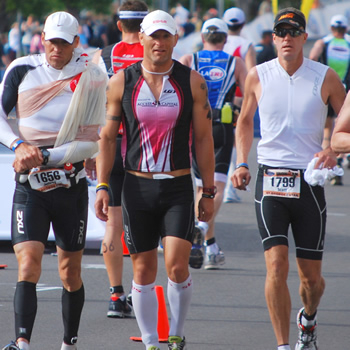
Jeff Rhodes: Perhaps Jeff hasn’t had the same level of adversity as the guys mentioned above but he has inspired us nonetheless. Jeff just completed Ironman St. George with a dislocated shoulder and a broken collarbone. I don’t want to give away the ending so check out the full story here at Ironmanlife.
We all race for our own reasons. Some race to get into shape, others to check a box off on their life’s goals, and others to win. Whatever your reason, it’s always great to find someone to inspire you. Here are some really inspirational guys.
RACE REPORT: OC 1/2 MARATHON
Ron Saetermoe
 I love the ½ marathon. For me, there is no better run preparation for the full or ½ Ironman. It’s long enough to help you with your run endurance but short enough for you to recover from it in a couple days.
Sunday, May 1st was the 2010 OC Marathon and Half Marathon. I did this race last year and took fourth in the M50-54 age group. Pretty good, since I don’t really consider myself to be a runner.
The race starts at Fashion Island in Newport Beach and winds its way around through the Back Bay and finishes at the Orange County Fairgrounds in Costa Mesa. The marathoners continue up through Irvine and Santa Ana before turning south down the Santa Ana River Trail and finishing at the Fairgrounds.
Most of the racers parked their cars at the Fairgrounds and took the buses provided by the race organizers over to Fashion Island. I parked at Fashion Island and had my mom drive me back to get my car later. Thanks mom!
Those of you that know me know that I like to get to stuff early, because you just never know . . . Yesterday was no exception. I had plenty of time to use the restroom and warm-up.
It was an absolutely beautiful day for racing. The air was still, the sky was clear and it was cool.
My plan was to set out at a 7:00 minute per mile pace and see if I had enough energy to pick it up. 7:00 minute pace puts you at about 1:31:43, which just happens to be my PR from January this year. Eventually I hope to crack the 1:30:00 mark, which is 6:52 pace.
I had my Garmin with me so I was getting updates every mile. As the miles ticked by I was right on track. It was great because there was a guy obviously with the same objectives as me because we were both going the exact same speed. While he was about 20 years younger than me, his form was amazing! Perfect, fluid strides with his hands held high. A true inspiration.
This is really a great course that is fairly flat. There are a few bumps here and there but it is a pretty fast course. I stayed with my younger adversary until about mile 10 where he dropped me on a short, steep grade. If you know the Back Bay you know the grade I’m talking about where the bike trail meets East Bluff Drive. After that, he slowly pulled away.
My pace dropped on that mile to 7:18 and I was getting tired so I knew then there would be no PR today. Didn’t matter, it was still a great day!
Here are some results from folks we know:
Dave Aronne (1:25:41/6:33 pace, 1st M50-54)
Mike Burton (1:30:38/6:55 pace)
Ron Saetermoe (1:32:30/7:02 pace, 3rd M50-54)
Ryan Ritchie (2:03:18/9:25 pace)
Ly Ly Ta (Full marathon, 6:10:48/14:09 pace)
LANE LINES
Ron Saetermoe
These days I usually only swim twice a week. My goal for this season is to improve my cycling performance so I decided to cut my swim workouts back to two a week and increase my cycling workouts to four a week. It must be working because I had the fastest bike split at Ironman California 70.3 in my age group!
That doesn’t mean I don’t value my swim workouts, because I do. Like most of us, I’d like to keep my same swim splits but without working as hard at it. Naturally, that isn’t how it works, but we’d like it nonetheless.
My swim splits have been slower this year but I’ve always said I’d gladly give up 20% of my speed in the swim for a 20% gain on the bike. Be careful what you ask for!
Every triathlon coach has his or her own opinions about the best way to train and I certainly have mine. I’m always amused when I see swimmers at the pool sidle up to their lane with these gigantic duffle bags full of swim gear. I was especially amused this morning when I saw a guy with a “rolling bag” and a duffle bag.
This guy was ready for anything having to do with swimming. I mean www.swimoutlet.com must have made a killing off this guy! He even had the size 12 mono-fins!
Here’s what I do when I go to the pool: I get in. I do two, 1,500-meter sets. Then I leave.
I don’t do drills. I don’t do other strokes. I don’t intervals. And I certainly don’t have all that other gear.
You’ll be learning more about my swim philosophy in upcoming newsletters and the soon to be announced Triathica Academy. Here’s a preview: NO MORE DRILLS!
Cheers!
