
TRIATHLON RETURN ON INVESTMENT
Get More for Your Money, Jarrett Pfleiger
Look around at any triathlon race and you will see that most triathletes are not afraid to spend money on their sport. If we think a piece of equipment will make us faster and give us an edge on our competitors, most of us will probably buy it. Bikes the price of a used car, the most cutting edge running shoes, the most buoyant wetsuits money can buy, all to shave a few seconds or minutes off their race times.
There are new technological advancements being made in the sport every day. Bikes are lighter and more aerodynamic than they have ever been. Wetsuits are more buoyant and friction resistant, and shoes are lighter and perform better. One could spend a small fortune trying to have the best equipment out there, and some do.
Even though some equipment out there is amazing and can definitely shave time off your races, you may not be getting as much return on investment as you could by spending your money elsewhere, such as with coaching or a good training plan. 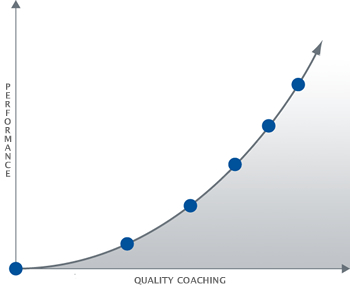
For a good cyclist, a nice bike could shave minutes off bike times, but for novice to average cyclists, the performance improvement is not as dramatic. The advantage in aerodynamics and weight is most dramatic for cyclists pushing the boundaries of human performance. For the average Joe, the gains in performance may not be worth the cost.
Buying a high-end bike when you are still a beginner is like spending a ton of money on the best wetsuit if you are not a good swimmer. Yes, more expensive wetsuits are more buoyant and create less friction in the water, but performance gains are really only noticeable for swimmers that already have their technique and speed down and just need that extra edge. If you are just an average swimmer, an entry-level wetsuit will be perfect. I recently bought a brand new Xterra wetsuit for $99 on sale and I love it. Just look for the deals and don’t feel like you need to drop over $500 on the next best thing.
Basically what I’m saying is to look for how much you are getting for how much you are paying, or “return on investment.” Is $5,000 for the new triathlon bike worth the few minutes you might save? What if you invested a little money in some coaching to raise the efficiency of your pedal stroke, a good bike fit to squeeze some extra power out of your legs, and/or a good training plan to make you a better cyclist. What about taking the hundreds of dollars you save by not buying a cutting edge wetsuit and invest it in some swim coaching, or maybe some good video analysis, to really cut minutes away from your swim time. I guarantee that for an average or below average swimmer, just a few swim coaching lessons will make you much faster than a top wetsuit will over an entry level wetsuit.
Don’t just throw money at your weaknesses; you need to tackle them head on. So many times people see our endless pool and get scared when they see the mirror at the bottom of the pool, or our underwater camera. Many are terrified to see themselves swim, which makes no sense to me. If you know you have bad technique, you should do everything you can to fix it, not spend $500 on a wetsuit or a small fortune on a bike and hope it goes away. From our experiences here at Triathica, most of the time, its only one or two little technique tweaks that make a HUGE difference. At just over $30 a pop per coaching lesson at Triathica, that’s a pretty good return on investment if you ask me.
If money is no option and you can afford all the best equipment and good coaching, then do both. But if your funds are limited, and you have to choose between that new carbon fiber bike or some good quality coaching to bring up your weak points, you will get more return on your investment with good coaching and training every time.
SPIN POWER DVD
Jarrett Pfleiger
 Are you ready to take your cycling performance to the next level? Stop wasting time by logging mile after mile outside on your bike. You can get a better workout done in less than half the time by training harder and smarter indoors.
Sure, the scenery isn’t as good, but if you are serious about improving your performance on the bike, you need to add indoor training to your regimen. Focus completely on your workout without worrying about cars, stoplights, obstacles, flats, other riders, etc. All you need is an indoor trainer or stationary bike, and we will provide the workout and motivation.
Triathica would like to introduce the first DVD in the Triathica Academy series, Power Up! Power Up is a 60-minute spin workout designed to help build your leg strength to climb hills and power through the wind. The DVD will lead you through a series of intervals that will test your ability to generate power on the bike by continuously varying cadence, power (watts), and interval duration. The interval timer is accompanied by video of a spin class held at Triathica triathlon training center in Lake Forest, CA. The video is led by Ron Saetermoe, president of Triathica and USAT certified coach.
For each interval we will tell you which training zone you should be in. Don’t know your personal training zones? No problem. We will provide a test you can perform at home to find your zones. Knowing your training zones is valuable for making sure you are training at the appropriate intensity every time. Don’t waste time training in too low of a zone, or burn yourself out too soon by training in too high a zone. Test your heart rate zones before you do another workout. You can use this same test as a marker set to track your progress as you become stronger on the bike. Retest every few weeks and adjust your zones accordingly.
Stay tuned for more training DVD’s from Triathica as we continue to develop the Triathica Academy series. We are dedicated to enabling anyone and everyone to reach their triathlon and multisport goals. Let us help you train like a triathlete.
Please click here to purchase the DVD.
MARKER SETS
Ron Saetermoe
Any good goal has several elements to it: it’s measurable, achievable and has a timeframe. Marker sets include all of these elements.
A marker set is a very precise workout you can repeat over time to track your performance improvement. Precision is very important because if you don’t have a controlled environment there may be other influences at work that skew the results. For example, if you use a three-mile course around your neighborhood to test your cycling performance there may be factors that impact it beyond your performance.
For example, some of the factors might include temperature, humidity, wind and traffic. Each time you do your course the conditions will be different, sometimes dramatically so. As a result, you’re not really getting a good gauge of your performance.
For that reason alone I’m harping on the benefits of training with watts. When you come to Triathica for a CompuTrainer session, we can duplicate the workout you did a month ago quite precisely.
So what’s an example of a marker set? Here’s one for cycling. The cadence stays at 90 throughout.
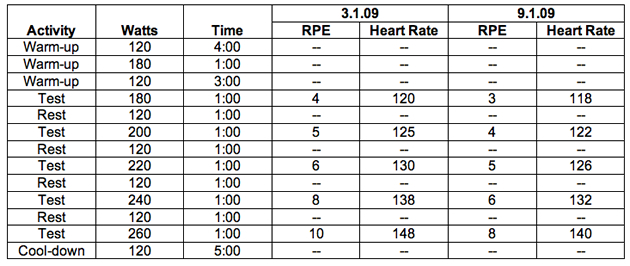
In this example, the second marker set was performed six months later and the athlete shows a considerable performance improvement in terms of rating of perceived exertion (RPE) and heart rate. This is what you would expect to see from an athlete that was actively training and getting the proper rest.
Believe me, besides your races, there’s little more motivation than to see your performance improve in this way. Last night for example, I tested myself on the treadmill and found that my average heart rate dropped from 170 to 162 at a 7:00 sustained pace on the treadmill. That’s nearly a 5% performance improvement. That’s huge.
Give us a call if you’d like to learn more about marker sets.
Cheers!
BIKE MS: BAY TO BAY TOUR
Felicia Jones
 If you are wondering what dumb thing I am doing now, here it is . . .
Why am I doing this (the Bike MS: Bay to Bay Tour on Saturday, October 10th/11th)? Felicia isn’t THAT kind of cyclist! I do understand that this is probably beyond my normal riding capabilities, but who am I to turn down a challenge?
This is a race in support of someone I greatly admire and wish that everyone can one day have the pleasure of meeting. Lynette is the spouse of a teammate and is a woman whose magnetic spirit always stays with you. Dave and Lynette have been fighting MS together for many years and in honor of the love and devotion the two have for each other (high school sweethearts, and still sweethearts) I want (and need) to ride. Dave and Lynette are great examples for how each of us should live our lives and love those that are a part of it.
I am really riding this grueling race because Lynette can’t. AND if she could, she would probably beat Dave.
I understand that times are tough, but I would appreciate if you could donate even a few dollars (you don’t have to post an amount on the page). If everyone donates just one dollar, and I send out 1,000 emails . . .
So, since I don’t like to ask people for money, I have come up with a way to reciprocate for those that are eager to donate. Here are the donation levels:
$25 “Hungry Hippo” – You will receive 1 dozen homemade chocolate chip cookies or 1 pint of homemade salsa. You must be semi-local for delivery.
$30 “The Chef” – You are invited to a cooking class at my house where you learn how to bake chocolate chip cookies and make the infamous “Felicia’s Salsa.” Wine will be served, of course.
$50 “Wax On, Wax Off” – I will come to your home, if you are semi-local, and wash your car. This includes external washing, shine on the tires, and the windows. (Only one car, SUVs and minivans extra.)
$75 “Auntie Daycare” – I will watch your kids for 3 hours. This only includes your kids and a date will have to be negotiated. This only works if I live within 2 hours of your home or make a habit of coming to visit where you live (that is pretty much everyone); and that I like your kids.
$100 “Place Your Ad Here” – Body marking. Yes, there it is, I said it. I will post an ad for you, on my body, on race day. Now, this is limited to space (legs and arms only), and will have to be re-applied for the second day of the race (I plan on showering). This can be drawn by you, me, or my team members the morning of the race. I will supply minimally 4 marker colors (black, red, green, blue), but it must be something that I can show to my grandmother.
$150 “In Your Face” – You will be invited to watch the race (Day 1 Carlsbad, Day 2 San Diego) and to laugh and take pictures as I come crawling across the line. Sign making materials will be provided for you to express yourself to the racers (i.e. “Felicia is da bomb!” or “Only 80 more miles to go!”) Those that make it to Carlsbad are invited to stay in the beautiful Carlsbad Residence Inn for the night and wish us well the next morning. Continental breakfast will be served.
$200 “You Have Got to be Kidding?” – At this donation level I will deliver a singing telegram from you to a recipient that is semi-local. This could include costume and, of course, dancing and clowning around. You must understand that the only songs I know all the words to are “Happy Birthday” and some Christmas carols, but I am sure we can work something out.
If you don’t want to take advantage of any of these prestigious parting gifts, any amount you are willing to donate will be greatly appreciated.
Anyone want to join me for a ride?
NEWBIE NERVOUSNESS
Ron Saetermoe
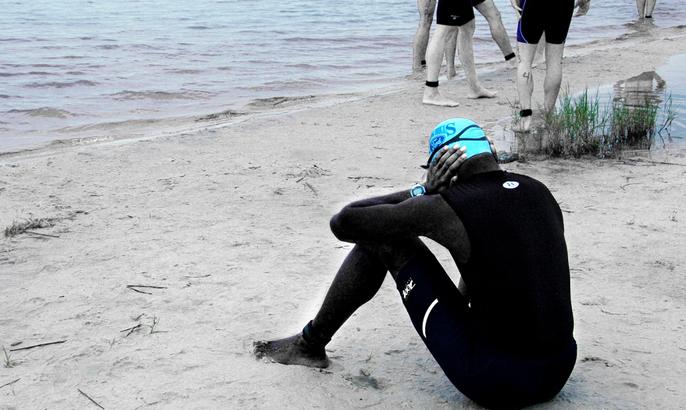
The terror on the “newbie’s” face is humorous. That’s because the terror is on someone else’s face, not mine.
Many new triathletes (newbies) seem to have come to the sport in similar ways – one of their “friends” coaxed them into it. That’s how I started, and to this day I can’t thank Greg Fitts enough for the encouragement.
The problem is that most come to the sport ill prepared. Sure, there are coaches and triathlon clubs out there, and great organizations like Team in Training, but most new triathletes enter the sport without a lot of guidance.
Granted, the vast majority of newbies just want to survive their first race, but secretly I think they also want to feel good about their performance. That’s where a good coach comes in. A good coach will help get you physically and mentally ready for your big race.
Triathlon is very simple, but very complex at the same time. I mean, who would think it would be so darn hard to put on your singlet when you’re wet? Some day I’m going to shoot video in the transition area of a race and put together a “Funniest Transitions” video. It is hilarious.
Triathlon is simple because all you have to do is swim, cycle and run. Even the most unfit amongst us can “complete” a triathlon, whether they believe it or not. However, getting beyond just surviving takes much more.
Here are a couple tips:
1. Get a coach: Of course I’m going to say that, right?
2. Read: There are a ton of books and magazines out there. Triathlete magazine and Competitor magazine have great articles for the newbie. www.beginnertriathlete.com is another great resource. I also like the Wes Hobson book called Swim Bike Run.
3. Get a plan: If you just go out and swim, bike and run without a plan you’ll never reach your full potential. I’ve posted my “ideal” workout week here before and I really try to stick with it.
4. Measure your performance: Periodically do “marker sets” which is a particular workout you do at different times of your season to see how much you’ve improved (more in this newsletter).
We’ll be starting a newbie triathlon camp here soon so stay tuned for more information on that.
Cheers!
