
PARATRIATHLETE SARAH REINERSTEN ON ESPN MAGAZINE
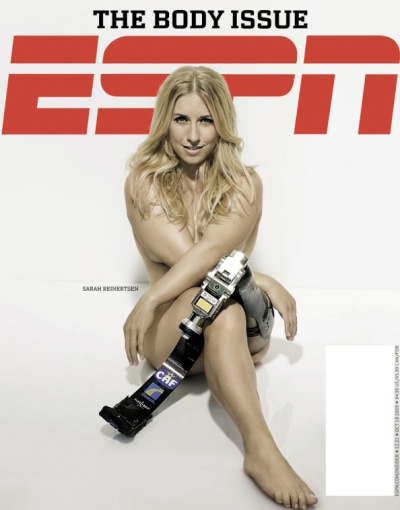 Sarah Reinersten was the first female amputee to finish the Ironman World Championships race in Kona. She recently became one of the few athletes selected for ESPN Magazine’s “Body Issue.” Check out the local Trabuco Canyon resident’s ESPN Magazine cover here:
http://www.triathlon.org/news/article/paratriathlete_reinertsen_bares_all_in_magazine_first/
You can read more about Sarah here:
http://www.triathlon.org/news/article/in_profile__sarah_reinertsen_usa/
STRENGTH TRAINING FOR CYCLISTS
Jarrett Pflieger
 Strength training in endurance athletes has been shown to increase muscle efficiency, increase average power output, decrease injury, and help control body composition. There is no better time to start incorporating strength training into your training regimen than in the off-season.
In triathlon, it seems the event that is most affected by strength training is cycling. Cycling is probably one of the least technical of the three sports in triathlon since you are locked into one position on the bike. With swimming and running, you always have to think about body position and form. On the bike, there are some technical aspects, but for the most part, you just have to worry about turning those pedals with the largest and strongest muscles on your body, your glutes, hamstrings, quads, and calves. Any exercise that strengthens these muscles will be a benefit to your cycling performance.
Here are some different exercises you may want to try out. Disclaimer: Always consult a professional before trying exercises you are not familiar with. You could get seriously hurt. If you do not have proper form, you should not perform these lifts, period. Also, if you are a beginner, the best thing you can do to get better on the bike is to go ride your bike. Feel free to still strength train, but you need to focus on getting your muscles adapted to the demands of cycling by… cycling.
1. Squat
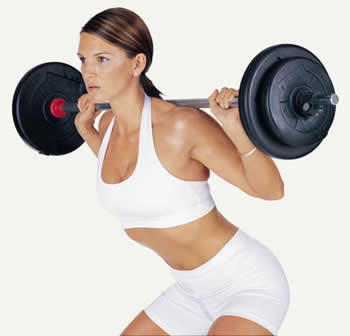
If I could only do one exercise for the rest of my life, I would probably pick the squat. It is the mack-daddy of all lifts. A properly performed squat will work your hamstrings, glutes, core muscles, and most of all, your quads. If you want to be able to hammer those pedals on the up-hills and in sprints, you need to have strong quads.
The key to a good squat is control over the weight. You should be able to keep a good natural bend to the spine all the way down until your thighs are AT LEAST parallel to the floor. One the way up, make sure you don’t lean forward and flare your rear out behind you. This puts unnecessary stress on your lower back. Keep the weight under control at all times and keep your whole midsection flexed and tight.
There are many variations to the squat including sumo squats, one leg squats, box squats, front squats, jump squats, etc. Master the standard squat before you try to perform any more advanced movements.
2. Deadlift
If the squat is the king of lifts, the deadlift is the prince. The deadlift is a great compound movement that works several muscle groups at once, similar to the squat. If you regularly perform deadlifts, expect to get very strong in your hamstrings, glutes, quads, and upper and lower back.
Strong glutes and hamstrings will help balance out your strong quads for a powerful and efficient pedal stroke. A strong upper and lower back will help you stay in the aero position for longer and stay more stable as you ride. The more stable you are on your bike, the more power that goes straight to the pedals and isn’t wasted wiggling around in the saddle.
A proper deadlift should include a naturally arched back, tight core, head facing forward, and your hips driving forward and not flaring out behind you. This is a good way to ruin your back. If you do not know how to perform a deadlift properly, please don’t try it without consulting a qualified trainer first.
3. Calf Raises
It may seem funny to work calves for cycling, but believe it or not, the stronger and more rigid your calves are, the more efficient you can transfer energy from your big thigh muscles to the pedals.
Standing calf raises are great for this. Find a calf raise machine or grab a dumbbell and stand on the edge of a platform. Grab on to something if you need to for balance. Make sure your calf raises are controlled and you aren’t bouncing up and down.
Start in the bottom position with your heel hanging off the edge of the platform. You should be feeling a good stretch. Raise yourself up on your toes until you can’t go any higher, make sure you squeeze your calf at the top and lower yourself back down slowly. Get a good stretch at the bottom before starting the next rep.
4. Lunges
Lunges are great because you alternate legs when performing this exercise. This mimics the movement on a bike where legs take turns moving the pedals. Grab a pair of dumbbells, a barbell, or just use your bodyweight. Step forward and squat down until your back knee is a few inches from the floor. If you are doing walking lunges, drag your back foot forward and stand up. If you are doing standard lunges, use your lead leg to drive your body back into the starting position.
Make sure your lead knee is directly over the ball of your foot at the bottom of the lunge. If it goes way over your toe, you need to take a bigger step, if it is behind your heel, take a shorter step.
There are many variations to the lunge you can try like putting your back leg on a ball or platform to make the lead leg muscles work harder to lift your body. Master the standard lunge before moving on to variations.
Play around with these lifts, but make sure you start slow. Start with eight-to-ten reps of each movement for two-to-three sets. Once you get the movements down and your strength goes up, start increasing the weights and decreasing the reps. This will help you build a lot of strength without much increase in size. I like to perform three sets of five reps, which doesn’t sound like much, but the weight is pretty heavy. Listen to your body to see what feels right for you and don’t overdo it. Performing marathon sets of 15 reps or more is a waste of time. Your goal is strength and power, not more endurance training. You get enough of that on your bike.
You should see a pretty good increase in sustainable power on the bike in a few weeks and a few months of consistent training should transform you. Once again, unless you are an experienced lifter, consult a professional BEFORE performing these lifts. You can get seriously injured by going too heavy and/or using poor form.
NOVEMBER SPECIAL, SWIM TRANSFORMATION PACKAGE
 Do you dread the triathlon swim? You’re not alone. I’ll bet more than 50% of triathletes do.
If you’re interested in improving your swim performance in 2010, we’ve got the solution for you. No, it’s not more mind-numbing laps, it’s our Swim Transformation Package.
Here’s how it works:
Step 1: We videotape your stroke, analyze it, provide feedback and a DVD copy for you.
Step 2: You receive five personal training sessions in our Endless Pool.
Step 3: We videotape your stroke again and review your improvement.
And here’s the best part: if you don’t think your stroke has improved after your five sessions we’ll refund every penny!

Contact Jarrett@triathica.com or call 949.273.6223 for more information.
DO YOU THINK YOU CAN GO FASTER? I DO TOO!
Ron Saetermoe
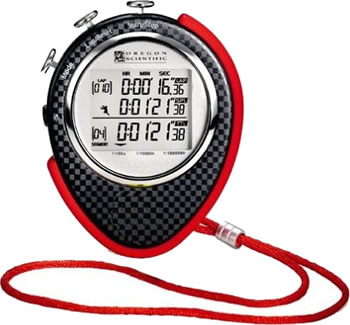 Strange isn’t it that during a race we feel as if we’re going as fast as we absolutely can then afterward think that we could have gone a little faster? Naturally, after the pain has subsided, faster seems quite possible.
My goal for every race is to feel good about my performance. That’s it. That’s my goal. Of course, if I better my time from last year, or manage to reach the podium, I’m quite happy about that. But most of all, I just want to feel good about my performance.
For example, my “A” race this year is Ironman Arizona on November 22nd. In order to do my best there I’ve had to sacrifice my racing performance to a degree to keep up with my training plan (yes, I use a training plan – I don’t just suggest you use one). My performance at the OC Triathlon this year was quite good considering I rode 70 miles the day before and followed that up with a short transition run.
My time in 2008 was 2:34:51. 2009 it was 2:28:40. I’d improved my time even though I trained hard the day before.
A couple weeks ago I won my age group at the Magic Mountain Man ½ Ironman. I didn’t plan it that way; I just raced my race and ended up winning.
Everyone has different goals when it comes to triathlon. For my friend Russ Jones, it’s winning. At one point he had over 30 consecutive age group wins (and many of those were OVERALL wins). My friend Kirk Matkin’s goal is just to have fun (if pain to you is fun). He joked that at the Honu ½ Ironman this year that he was going to take pictures all day and send them to us. It just gives you an idea of how our goals are different.
Going faster is a combination of a lot of things. Improvement in form, fitness and nutrition all contribute to it. Understanding the nuances of the race as well as your own body contribute too. It’s a lot of things, including some luck.
Do I think you can go faster? If that’s your goal, I’m sure you can. If you want to know how, you know where to find us.
Cheers!
